
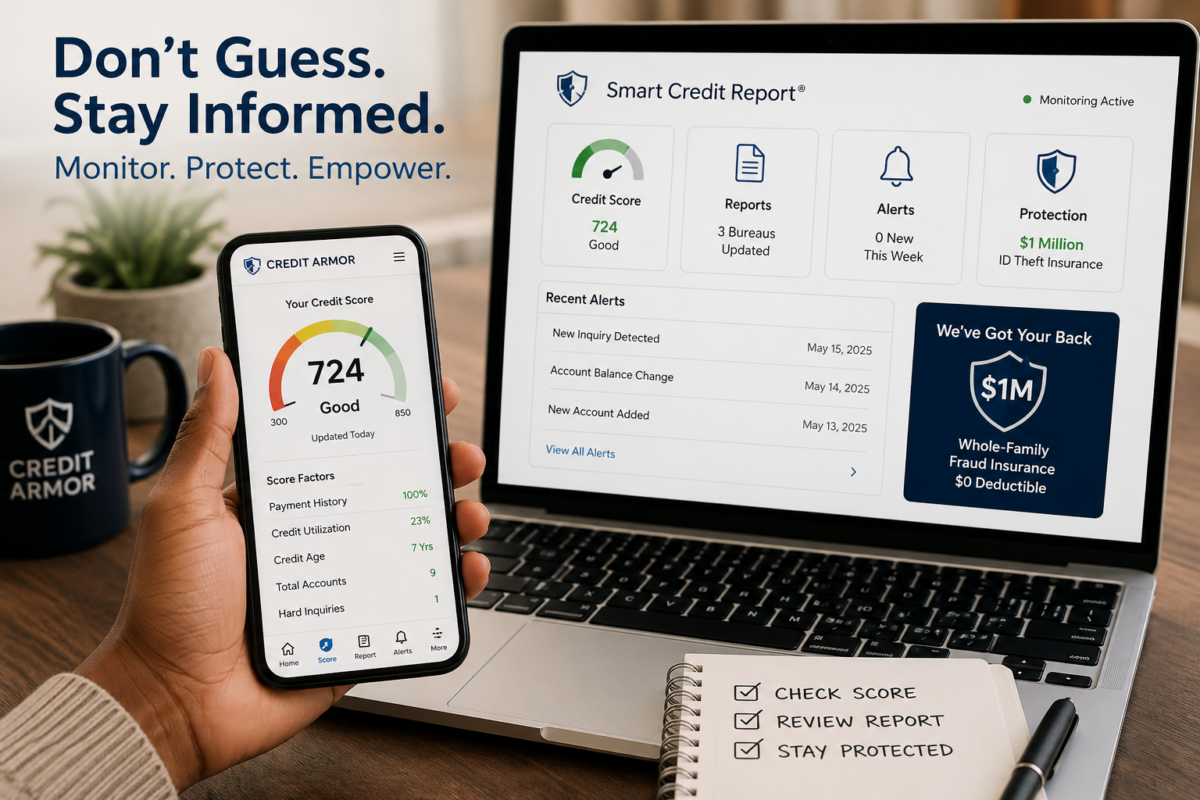
At Credit Armor, we hear the same myth constantly: checking your credit score will make it drop. It’s one of the most persistent — and most damaging — pieces of financial misinformation out there, and it’s exactly why so many people avoid their own credit report altogether.
Here’s the truth: the soft credit checks you’d use through a monitoring app, like the ones built into your Credit Armor Smart Credit Report, don’t hurt your score at all. Avoiding your credit score doesn’t protect it — it just leaves you blind to problems that are often easier to fix the sooner you catch them, including identity theft and fraud.
Why Monitoring Matters More Than Ever
Banking and credit apps have made it easier than ever to keep tabs on your score, and bundling that information in one place (which is exactly what our Smart Credit Report® is built to do) means you’re far more likely to actually check it. That matters, because a 2012 Federal Trade Commission study found one in five Americans had an error somewhere on their credit report, and 5% had errors serious enough to actually hurt their score — leading to higher prices on loans and insurance.
Disputing inaccurate information isn’t always fun, but it can make a real difference to your creditworthiness. That’s the entire idea behind Dispute Armor: our AI scans your report for over 20 different types of errors, and more than 80% of the reports we scan turn up mistakes that could be dragging a score down unnecessarily. Most people, even credit experts, never catch these on their own.
Hard Pulls vs. Soft Pulls
Understanding the difference between these two types of checks is the key to understanding why monitoring your own credit is completely safe.
Hard credit checks are the kind lenders, credit card issuers, utilities, cell phone providers, and even landlords use to fully assess your credit before extending you anything. Because a third party is pulling your file, it does ding your score — typically just one to five points. That impact fades within a year, and the inquiry itself drops off your report after two years. Minimal damage, short shelf life.
Soft pulls, on the other hand, never touch your score. These are the checks you get through your bank or a credit monitoring service like ours, and they let you see your full financial picture without any downside. Soft pulls are how you watch your credit move in real time — for better or worse — based on your own financial behavior. Some lenders even use soft pulls instead of hard ones; they may show up on your report, but they leave your score untouched.
Look Past the Number
Skipping your credit check is one of the most common financial mistakes people make, so if you’ve been avoiding it, you’re not alone — but it’s worth changing. Beyond the headline score, it pays to dig into the specific categories on your report. Your credit utilization ratio — how much of your available credit you’re actually using — is one of the biggest levers you have. Lenders like to see that ratio under 30%, and even sitting in the 20% range can start to affect your score. This is exactly the kind of thing our ScoreBoost® tool is designed to help you manage: it shows you, before you spend or pay down a balance, exactly what that move will do to your number.
Watch for Signs of Fraud
It’s also worth reviewing your hard inquiries regularly to make sure no new lines of credit were opened without your knowledge. If you spot activity you didn’t authorize, that could be identity theft — and you’ll want to contact your card issuer, the credit bureaus, and potentially law enforcement right away. Credit card issuers require notice of suspected fraud within 60 days of your statement date, so keeping a close eye on your statements is essential.
This is where a layered approach helps most. Our Credit Monitoring Alerts flag changes to your report by phone or email the moment they happen, and our Action Buttons let you respond immediately — reporting identity theft, resolving reporting problems, or contacting a creditor directly, with no forms, letters, or hold-music phone calls. And because identity theft doesn’t always announce itself, every Credit Armor membership includes $1 million in whole-family fraud insurance with zero deductible, covering everything from bank accounts to the out-of-pocket costs of recovering your identity.
The Bottom Line
Your credit score isn’t something to check and then hope for the best — it’s something to arm. Regular monitoring, understanding the difference between hard and soft pulls, and catching errors or fraud early are the real keys to protecting your financial future. That’s the whole philosophy behind Credit Armor: get your score, monitor your score, arm your score.