

Nobody hands a landlord your pay stubs before they hand over the keys. They don’t call your last five credit card companies to ask if you pay on time. They pull one number and let it speak for you. That number is your credit score, and most people never look at it closely enough to know what it’s actually saying on their behalf.
A 2025 survey found that roughly one in four Americans hasn’t checked their score in the past year. Part of the reason is that credit scoring feels like a black box, full of rules that contradict each other: pay off a card and your score dips; carry a small balance and it climbs. No wonder people would rather not look.
At CreditArmor, we think the opposite instinct is the right one. Get the score, understand it, and keep an eye on it, because that number quietly follows you into almost every major financial decision you make.
Why This Number Runs So Much of Your Life
A credit score is a three-digit shorthand for how reliably you’ve borrowed and repaid money in the past. Lenders use it to decide your interest rate. Landlords use it to decide who gets the apartment. Cellphone carriers use it to decide whether you need to put down a deposit. Even some employers glance at a version of your credit history before extending an offer.
A weak score doesn’t just cost you a rejection letter; it costs you money in the form of higher interest rates on every card and loan you’re approved for going forward. A strong score does the reverse: better rates, fewer deposits, and one less reason for anyone to say no.
That’s also why we built the Smart Credit Report® to go beyond the single number most people fixate on. It surfaces your Auto Score, your Insurance Score, and your Hiring Risk Index alongside your general credit score, because a car lender, an insurer, and an employer aren’t all reading the same version of your history.
Your Report Feeds Your Score, Not the Other Way Around
Experian, Equifax, and TransUnion — the three major credit bureaus— each keep their own file on you. That file, your credit report, holds your identifying information along with every account, collection, lien, and bankruptcy tied to your name.
Your credit score is simply a calculation run on top of that report. Different bureaus, different data, different scores: it’s why you don’t have one credit score, you have several, and they don’t always match. CreditArmor pulls all three bureau reports into a single Smart Credit Report so you’re not requesting three separate files just to see the full picture.
For decades, FICO was the only scoring model that mattered. That changed in the early 2000’s. All three credit bureaus started a joint venture and created VantageScore, a competing model to FICO scores. And VantageScore has picked up a bigger share of the marketplace ever since, though FICO still dominates lending decisions.
What Actually Moves a FICO Score
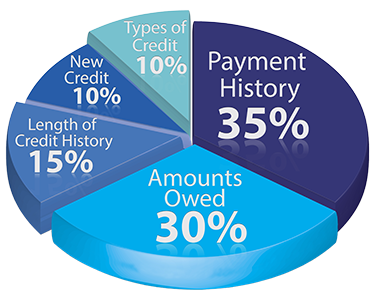
FICO won’t publish its exact formula, but it does tell us how much weight each category carries:
- Payment history — 35%. Nothing moves the needle like on-time payments, and nothing damages it faster than a missed one. This is the category CreditArmor’s Credit Monitoring Alerts are built around: the instant a late payment posts to any of your three reports, you’re notified and can respond with a single Action Button rather than tracking it down yourself.
- Amounts owed — 30%. This measures your balances against your total available credit, better known as your utilization ratio. ScoreBoost® exists for this exact number: it models how a payment or purchase will move your score before you make it, instead of after.
- Length of credit history — 15%. Time in the system counts in your favor. ScoreTracker charts this over months and years so the trend is visible, not just the current snapshot.
- Credit mix — 10%. Handling a card, a loan, and maybe a mortgage responsibly shows lenders you can juggle different kinds of debt. Money Manager® lines up every account you hold in one dashboard, so your actual mix is easy to see.
- New credit — 10%. A cluster of hard inquiries in a short window reads as desperation to a lender. If you get turned down for a card, don’t chase another one right away; if you’re shopping loan rates, keep it within roughly 45 days so the inquiries count as one. ScoreBoost’s planning tool flags when it’s safe to apply and when it’s smarter to wait.
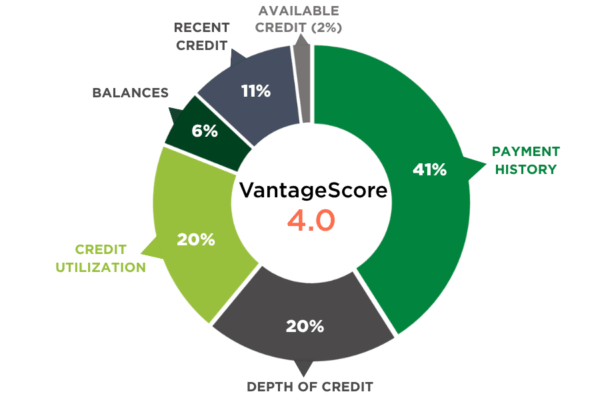
VantageScore weighs six categories instead of five: payment history, depth of credit, utilization, recent credit, balances, and available credit.
Where You Actually Fall
FICO scores run from 300 to 850, and every lender sets its own cutoffs for “good” or “bad.” Broadly, scores sort into five bands:
The first FICO Score Credit Insights report put the national average FICO score at 715 as of September 2025.
VantageScore 3.0 and 4.0 share the same 300–850 scale, with slightly different band cutoffs:
Access to several pulls of the Smart Credit Report is included in every CreditArmor plan. So instead of a once-a-year checkup, you can see exactly which band you’re in whenever you want.
Monitoring That Actually Keeps Up With You
A score isn’t fixed; it moves with every payment, balance, and inquiry. Historically, staying on top of that meant paying for a subscription service just to see your own information.
A few card issuers now offer a courtesy score at no charge — Bank of America partners with TransUnion, Wells Fargo with Experian — but each only shows you one bureau’s version of one score. CreditArmor’s approach is broader: three-bureau reports and scores in one login, plus Credit Monitoring Alerts that fire in real time whenever a new account, inquiry, or negative mark appears on any of them. When something needs attention, an Action Button lets you respond on the spot instead of filling out paperwork or sitting on hold.
Habits That Actually Compound
Forget the noise around scoring models for a second. These are the habits that build a strong score over time, mapped to the same five factors above.
Make on-time payment the non-negotiable. It’s the single highest-leverage thing you control. It’s worth adding: in CreditArmor’s own scans of member reports through Dispute Armor, the large majority turn up at least one error, incomplete entry, or outdated negative mark that could be dragging a score down unfairly. Dispute Armor’s AI checks for more than 20 known error types and generates bureau-formatted dispute letters for however many accounts need it, with no limit on how many you file.
Keep utilization comfortably low. A common guideline is staying under 30% of your available credit, 10% or lower gets you the most points available. Pay the Credit Card statement in full when you’re able to. ScoreBoost will tell you exactly when the Credit Card company will report to the three credit bureaus. That’s a huge advantage to increasing you scores FAST. Carrying a balance and paying interest isn’t required to build credit. ScoreBoost is built to answer exactly this question before you spend: move the slider, see the projected impact, then decide.
Get in the game early, and don’t be afraid to make changes later. You can start building credit at 18, and even light, regular use, like a recurring $20 charge, builds real history over time. FICO scores open and closed accounts the same way, so closing a card that isn’t worth its fee is fine, though it’s worth knowing that doing so can shrink your total available credit and push your utilization ratio up. ScoreTracker lets you see that tradeoff play out instead of guessing at it.
Let your accounts diversify naturally. Where it makes sense financially, a mix like an auto loan or a personal loan used to consolidate card debt can round out your file. Money Manager keeps every account type visible in one place, so you can track that mix without logging into five different apps.
Give new applications room to breathe. Sign-up bonuses and 0%APR offers are tempting, but stacking applications close together reads as risk to a lender. Spacing out your requests matters more than people think. ScoreBoost’s planning feature tells you when your score can absorb a new application and when patience is the better move.
Armor for What You Can’t See Coming
Building the score is one job. Protecting it from exposure and theft is another, and it’s the half of the equation most credit content skips entirely. PrivacyMaster® actively works to get your personal information pulled off data broker sites and alerts you if it resurfaces. Every membership also carries $1 million in whole-family fraud insurance with no deductible, covering bank, card, and brokerage accounts, out-of-pocket recovery costs, and fraud that happened before you even knew about it.
None of this requires becoming a credit expert. Pay on time, keep balances reasonable, borrow with intention, and put tools in place that catch problems before they cost you money. CreditArmor’s Protect and Build plans start at $1 for the first seven days, so you can see exactly where you stand before deciding what level of coverage you need.