
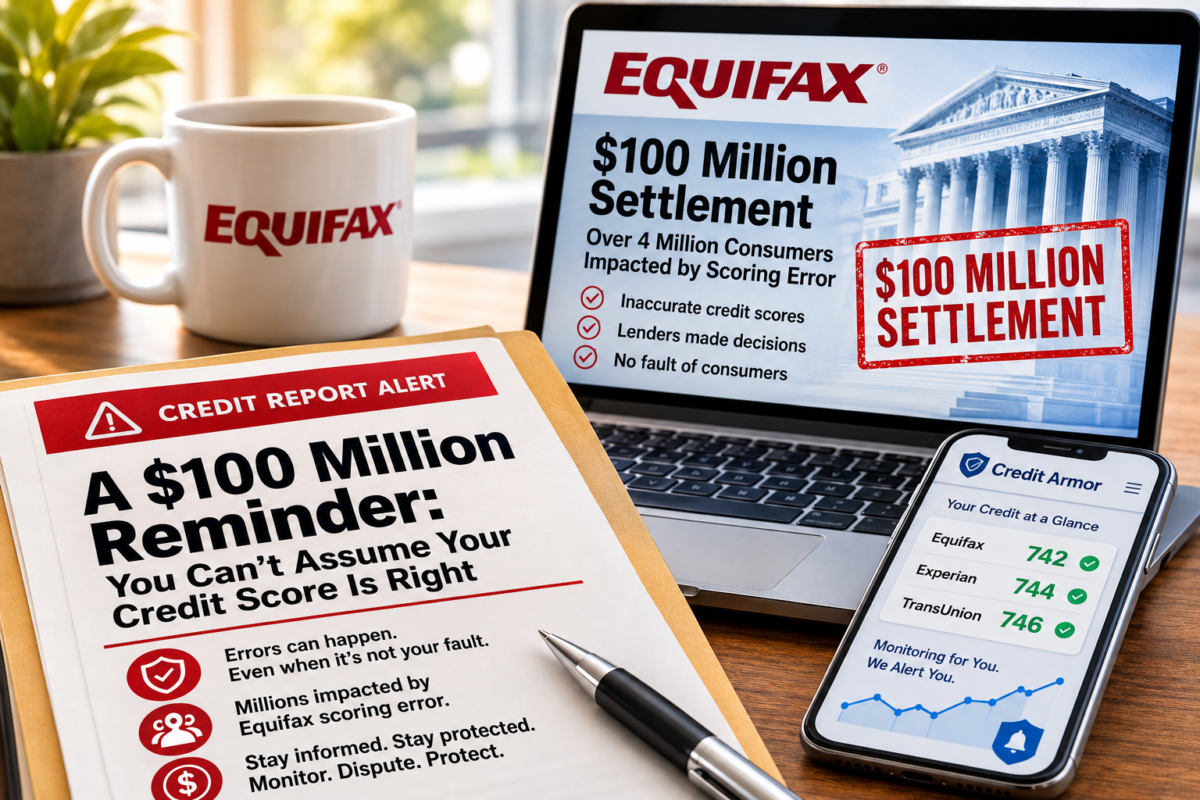
Millions of Americans just found out that a number they never questioned — their credit score — may have been wrong for weeks, through no fault of their own.
Equifax has agreed to a $100 million settlement over a coding malfunction in its Online Model Server that ran for roughly three weeks in the spring of 2022. During that window, the system generated inaccurate credit scores and attributes for a broad swath of consumers, and those flawed numbers went straight to lenders evaluating auto loans, mortgages, and credit cards. Borrowers didn’t cause the error. Many never even knew it happened. They just got a rate, a denial, or an approval based on data that wasn’t accurate.
That’s the part of this story we want to focus on at Credit Armor, because it’s the part most people miss: your score can be wrong, the mistake can originate entirely outside your control, and by the time you find out, the financial damage is already done. Monitoring and dispute tools exist precisely for moments like this one.
The Scope of the Problem
Roughly four million consumers nationwide fall within the proposed settlement class — anyone whose score or credit attributes were skewed by the glitch and passed along to a third party during a credit transaction. Getting here took nearly four years of litigation. Equifax isn’t admitting fault; the company disputes that it broke any federal reporting law and says it chose to settle rather than keep fighting in court.
Where Credit Armor fits in: A single-bureau check wouldn’t have caught this, since the error lived inside one bureau’s scoring pipeline. That’s why we pull and monitor all three reports — Equifax, Experian, and TransUnion — side by side. When one bureau’s numbers drift out of line with the other two for no clear reason, that’s a red flag worth an alert, not something a consumer should have to notice on their own.
Small Coding Error, Big Real-World Consequences
The malfunction ran from mid-March through early April 2022. In that stretch, an estimated 300,000 people saw their scores shift by 25 points or more — a swing large enough on its own to knock someone from a favorable rate tier into a much more expensive one, or to flip an approval into a denial. Some of the country’s largest lenders were on the receiving end of these corrupted profiles and made lending decisions based on them.
The human impact showed up in real terms: scores falling by triple digits overnight, financing applications rejected, and borrowers pushed into pricier backup loans they wouldn’t have needed otherwise. None of it stemmed from anything the borrowers did.
Where Credit Armor fits in: This is precisely the failure mode ScoreBoost® is built to catch. Rather than assuming your score is stable until a lender tells you otherwise, ScoreBoost lets you see how your profile currently reads and calls out abrupt, unexplained changes — the 25-point dips, the 100-plus-point drops — before you’re sitting across from a loan officer expecting terms you no longer qualify for.
The Error Doesn’t Have to Be Yours to Hurt You
Here’s the uncomfortable truth this case highlights: you don’t need a missed payment or a fraudulent account to end up with a damaged credit file. Sometimes the failure sits entirely on the bureau’s side, inside code the consumer will never see or understand. And even then, the work of catching it, proving it, and fixing it still lands on the consumer — usually with a loan decision already hanging in the balance.
Where Credit Armor fits in: This is what Dispute Armor was built to shorten. It’s an AI-driven tool that reviews your credit files for inaccuracies and generates a dispute tailored to each bureau’s format and requirements. Our data shows more than 80% of the reports it scans turn up at least one error dragging the score down. When something like the Equifax glitch happens, Dispute Armor means a consumer can push back quickly instead of quietly accepting a worse rate.
Reportedly the Largest FCRA Class Action to Date
This is being called one of the biggest recoveries ever obtained under the Fair Credit Reporting Act — the federal statute that obligates credit bureaus to maintain reasonable procedures for accuracy. FCRA’s statutory damages provisions for negligent or willful violations are what make a payout of this size possible.
The $100 million fund won’t shrink back to Equifax regardless of how many people file claims. Legal fees and administration costs come out first, and the remainder gets split proportionally among everyone who submits a valid claim. A federal judge still has to sign off before a dollar moves.
Not an Isolated Incident
This federal case is the latest in a series of actions tied to the same 2022 malfunction. Separate state-level settlements have already resolved allegations that the error misreported scores for tens of thousands of residents in at least two states, each ending in six-figure penalties. And in a different matter entirely — resolved in 2026 for a multimillion-dollar sum — Equifax settled claims that duplicate collection accounts had been posted to tens of thousands of credit files, also stemming from 2022.
Where Credit Armor fits in: Duplicate account entries are one of the more common errors our system flags, and one of the more damaging ones — a single unpaid collection reported twice can register as two separate delinquencies to a scoring algorithm. Ongoing monitoring is what catches that kind of duplication as soon as it hits your file, not months down the road after it’s already dented your score.
A Bureau With a Long List of Incidents
Equifax has been around since 1899 and is one of just three nationwide bureaus holding credit files on more than 220 million Americans. The 2022 scoring error is far from its only headline-making failure. In 2017, the company disclosed a breach that exposed Social Security numbers, birthdates, and addresses for nearly half the U.S. population — an incident that ultimately produced a multi-agency settlement worth up to $700 million.
And errors aren’t confined to Equifax. Roughly one in five Americans has at least one mistake on a credit report significant enough to hurt their score or cost them a loan. That single statistic is the reason products like ours exist: with only three bureaus controlling most of the credit system, consumers need their own way to check the work.
Where Credit Armor fits in: Beyond report monitoring, PrivacyMaster® actively searches data broker sites for your exposed personal information — the same categories of data (Social Security numbers, birthdates, home addresses) leaked in incidents like Equifax’s 2017 breach — and requests it be taken down. Because identity theft frequently follows that kind of exposure, every plan also includes up to $1 million in fraud insurance plus transaction monitoring, so a compromised identity doesn’t quietly turn into drained accounts or a wrecked credit file before you notice.
Why This Lands Differently Right Now
Timing matters here. U.S. households are currently carrying $1.26 trillion in credit card debt, and 90-day delinquency rates have climbed to 12.8%. Against that backdrop, a distorted score isn’t a minor inconvenience — it can be the difference between refinancing successfully and getting locked out of better terms entirely.
The roughly four million consumers in the proposed class still need a federal judge to grant preliminary and then final approval before payments can go out. Equifax continues to argue that most affected consumers saw no actual change in a credit decision, even while agreeing to resolve the case.
What This Should Tell You
The takeaway isn’t really about this one settlement. It’s that the systems generating your credit score are more fallible than most people assume, and there’s often no warning before an error shows up in a denial letter or a worse interest rate.
Credit Armor exists to close that gap before it costs you money: three-bureau monitoring to catch discrepancies and sudden swings, Dispute Armor to challenge errors fast, ScoreBoost to know exactly where you stand before you apply for anything, and PrivacyMaster with built-in fraud insurance to guard against identity theft. A $100 million settlement is a good reminder of what’s at stake — but the goal is catching the problem long before it ever gets to that point.